How to Specify Engineered Marble, Quartz, or Sintered Stone?
Specify resin-bonded engineered marble (Mohs 3 to 4, flexural strength 25 to 40 MPa per EN 14617-2) for dry commercial wall cladding, column wraps, and re-polishable lobby floors; choose engineered quartz (Mohs 6.5 to 7) for acid-exposed interior worktops below 120 °C; and select sintered stone (water absorption at or below 0.1% per ISO 10545-3, Class A1 fire rating) for UV-exposed facades and high-heat counters.
How Do Binder Chemistry and Mineral Matrices Separate These Three Slab Classes?
Mineral composition and consolidation physics govern every downstream performance limit across agglomerated and sintered surfaces. Both engineered marble and engineered quartz fall under EN 15285 and EN 15286 agglomerated stone definitions because crushed mineral aggregates are bound with 5% to 9% by mass unsaturated polyester resin under vacuum vibro-compression, whereas sintered stone belongs to ISO 13006 Group BIa ultra-compact porcelain.
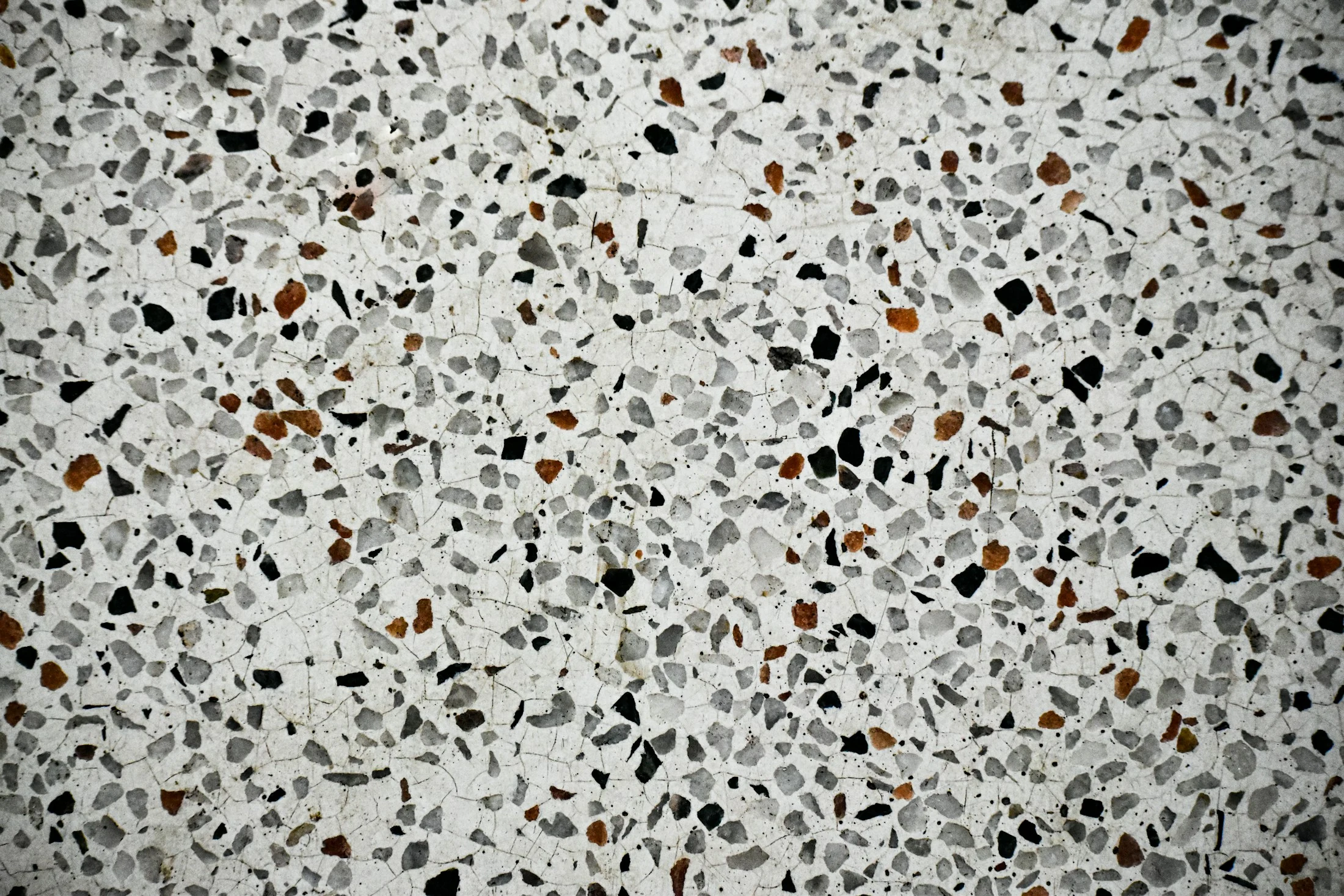
Engineered marble uses 90% to 94% crushed calcite or dolomite marble aggregate and calcium carbonate filler, producing a bulk density of 2.45 to 2.65 g/cm³ that saws, profiles, and diamond-polishes rapidly. Engineered quartz replaces carbonate filler with cristobalite and quartz sand for scratch resistance, while sintered stone compacts all-inorganic clays, feldspar, and mineral oxides above 400 bar before firing at 1,200 to 1,250 °C without organic binders.
Where Do Abrasion, Impact, and Acid-Etch Thresholds Diverge in Commercial Zones?
Surface Mohs hardness and EN 14617-10 chemical class dictate whether a slab survives food acids, wheeled luggage, or sand-tracked retail entrances. Calcareous engineered marble registers Mohs 3 to 4 and Class C1 under EN 14617-10 acid testing because citric, acetic, and hydrochloric acids react with calcium carbonate to leave matte etch rings, making it unsuitable for commercial kitchen prep or bar tops.
In dry vertical cladding, elevator lobbies, and boutique retail floors where pH-neutral stone cleaners are enforced, engineered marble provides high toughness against corner chipping and supports uniform in-situ diamond re-honing or crystallization after years of foot traffic. Quartz (Mohs 6.5 to 7, Class C4 chemical resistance) and sintered stone resist lemon juice, coffee, and bleach, though thin 12 mm sintered edges require a 1.5 to 2.0 mm chamfer to mitigate brittle impact spalling.
What Thermal, UV, and Fire Reaction Boundaries Restrict Exterior or Wet Use?
Unsaturated polyester resin introduces strict ultraviolet, thermal, and fire-reaction boundaries that separate agglomerated slabs from fired inorganic panels. Under EN 14617-11, resin-bonded marble and quartz exhibit linear thermal expansion coefficients of 18 to 32 × 10⁻⁶ °C⁻¹, roughly three times higher than sintered stone at 6 to 8 × 10⁻⁶ °C⁻¹, requiring wider movement joints and controlled indoor temperatures.
Direct solar UV radiation photo-oxidizes aromatic polyester chains, causing yellowing and micro-chalking on exterior facades or sunlit skylight wells; consequently, resin-bonded marble and standard quartz are restricted to interior envelopes. Sintered stone contains zero organic polymer, maintaining colour stability outdoors, withstanding 250 °C pan contact without scorching, and achieving non-combustible Euroclass A1 under EN 13501-1 compared with typical Bfl-s1 or Cfl-s1 ratings for resin-bound slabs.
How Do CNC Fabrication Yield and Installed Lifecycle Costs Compare?
Installed square-meter cost depends more on CNC feed speed, cutout breakage risk, and post-installation lippage grinding than on ex-factory slab pricing alone. Calcium-carbonate engineered marble cuts at 1.8 to 2.5 times the linear bridge-saw feed rate of sintered stone, lowers diamond blade wear, and contains minimal crystalline silica compared with quartz slabs during wet workshop profiling.
Sintered stone requires tension-relieving perimeter trims, specialized segmented blades, and slower waterjet piercing at sink corners to prevent stress propagation from kiln cooling gradients. For multi-story hospitality corridors, guestroom vanities, window sills, and decorative feature walls, combining engineered marble on high-volume architectural trims with quartz or sintered stone on wet pantry counters optimizes fabrication lead times and balances capital budget against long-term surface durability.
Standardized Specification & Benchmark Matrix
| Property & Standard Method | Engineered Marble (CaCO3 + Resin) | Engineered Quartz (SiO2 + Resin) | Sintered Stone (All-Inorganic) |
|---|---|---|---|
| Governing Product Standard | EN 15285 / EN 15286 / JC/T 908 | EN 15285 / EN 15286 / ASTM C1884 | EN 14411 (BIa) / ISO 13006 |
| Water Absorption (% by mass) | 0.02% – 0.30% (EN 14617-1) | 0.01% – 0.06% (EN 14617-1) | ≤ 0.10% (ISO 10545-3) |
| Flexural Strength (MPa) | 25 – 40 MPa (EN 14617-2) | 40 – 65 MPa (EN 14617-2) | 45 – 60 MPa (ISO 10545-4) |
| Mohs Scratch Hardness | 3.0 – 4.0 | 6.5 – 7.0 | 6.0 – 8.0 |
| Linear Thermal Expansion (°C⁻¹) | (1.8 – 3.2) × 10⁻⁵ (EN 14617-11) | (1.5 – 2.8) × 10⁻⁵ (EN 14617-11) | (0.6 – 0.8) × 10⁻⁵ (ISO 10545-8) |
| Fire Reaction & UV Suitability | Euroclass Bfl-s1/Cfl-s1; interior only | Euroclass Bfl-s1/Cfl-s1; interior only | Euroclass A1 / A1fl; interior & exterior |
Commercial Material Selection & Submittal Checklist
- Map each room schedule zone by exposure to pH < 5 acids, direct UV glazing, surface heat above 100 °C, and rolling trolley loads before locking slab chemistry.
- Request third-party lab reports citing EN 14617 (for agglomerated stone) or ISO 10545 (for sintered stone) issued within the past 24 months for the exact product series.
- Verify EN 13501-1 or GB 8624 fire reaction classification against building code egress requirements for high-rise corridors, elevator lobbies, and public atriums.
- Confirm slab thickness (15, 18, 20, or 30 mm) and maximum floor module edge length (≤ 800 mm for resin-bonded marble; ≤ 600 mm over radiant heating).
- Specify compatible bedding mortars—EN 12004 R2T low-alkali reactive adhesive for moisture-sensitive resin slabs and C2TE S1/S2 polymer cement for sintered panels.
Frequently Asked Technical Questions
Can engineered marble be installed on exterior building facades or open balconies?
No. Unsaturated polyester resin degrades under solar UV radiation and cyclic rain-heat shock, causing surface chalking, yellowing, and slab warping. Exterior cladding should use EN 14411 sintered stone, natural granite, or EN 13748-2 outdoor precast cement terrazzo.
Why do hotel projects still specify engineered marble instead of sintered stone for lobby walls and sills?
Engineered marble offers through-body aggregate edges that polish cleanly without 45-degree mitre joints, machines twice as fast on CNC profiling lines, and allows periodic in-situ diamond re-polishing if surface traffic dulls the gloss.
Does engineered marble pass Class A radioactivity requirements for residential and hospital interiors?
Calcite-based engineered marble typically exhibits internal exposure index IRa below 0.1 and external index Ir below 0.1 under GB 6566, well under Class A limits (IRa ≤ 1.0, Ir ≤ 1.3), though batch test reports remain required for project closeout.